Overview
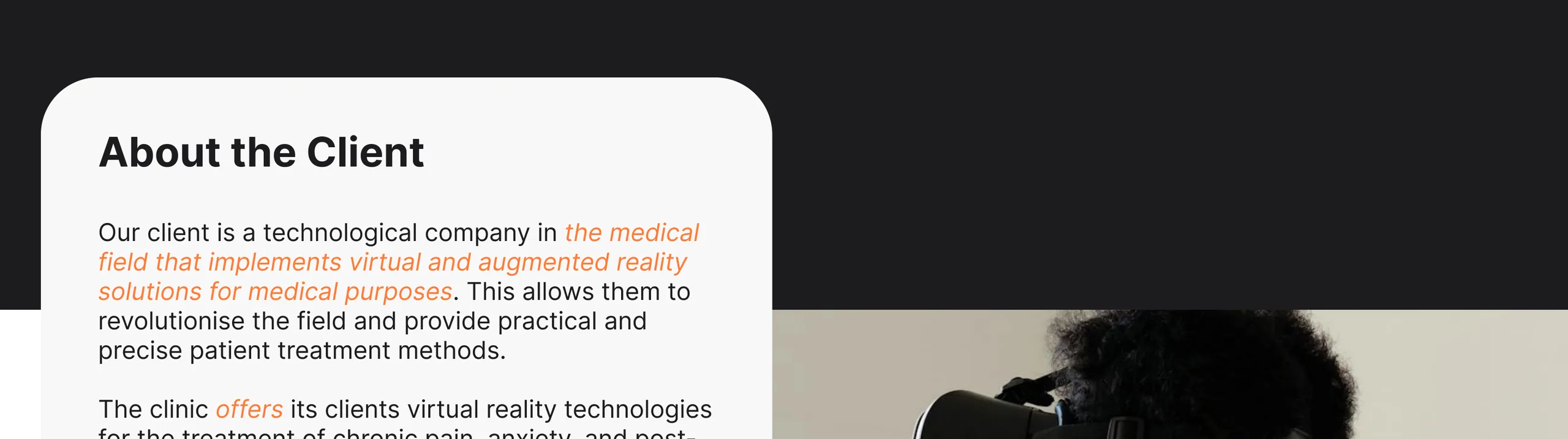
The programme centres on a technology company operating at the intersection of VR/AR and medicine, enabling clinics to use immersive tools for conditions such as chronic pain, anxiety, and post-traumatic stress, alongside rehabilitation for patients with physical disabilities. Dexis supported evolution of the product stack so clinical teams could rely on timely, interpretable signals from headset and session data.
Illustrative summary; client and metrics anonymised under NDA.
Challenge
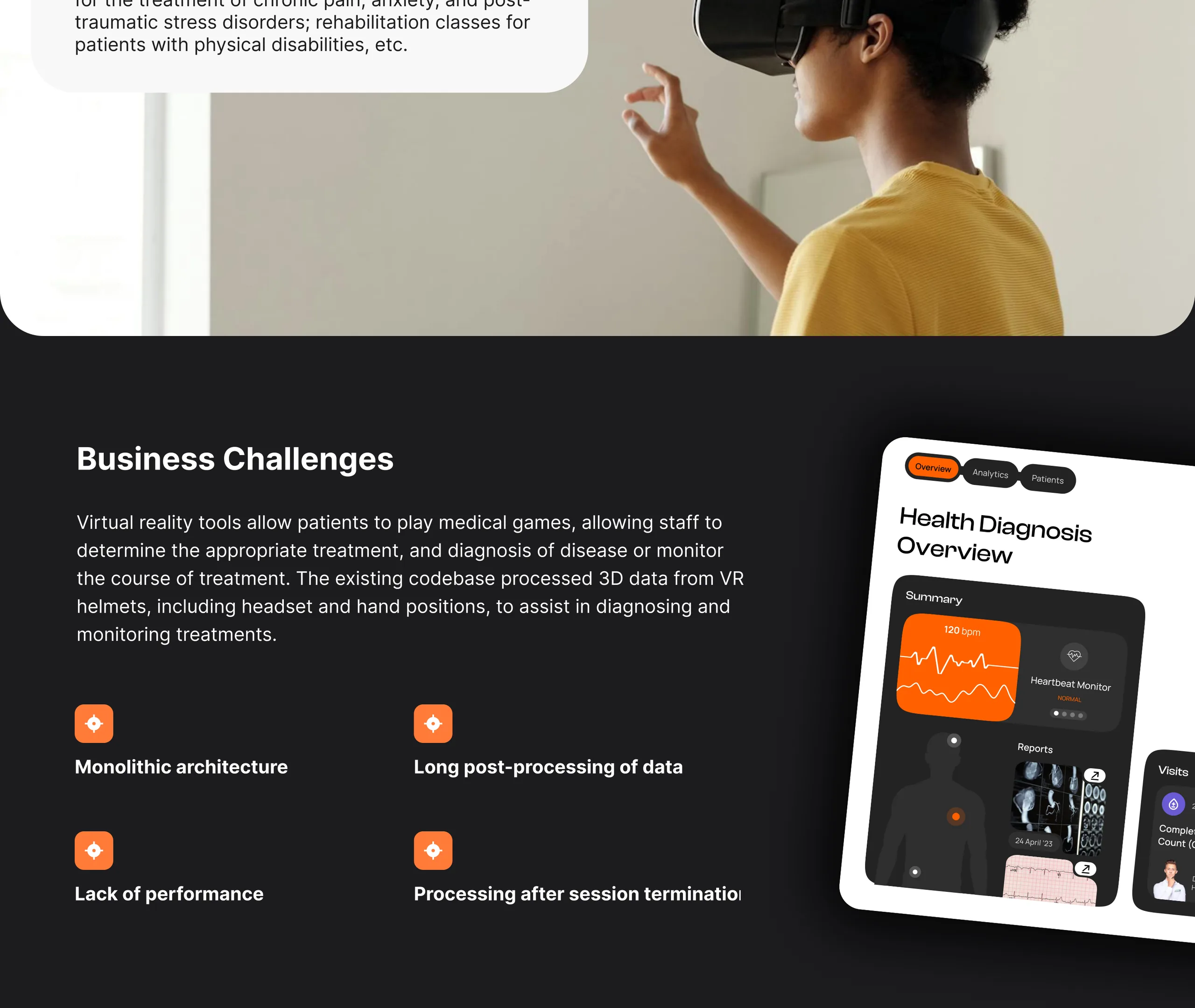
VR can turn therapy into measurable, engaging sessions - but the legacy system was held back by a monolithic architecture, long post-processing, and insufficient performance, with heavy work happening only after sessions ended. The codebase already ingested rich 3D data from helmets - headset and hand poses - to support diagnosis and monitoring; the task was to make that pipeline faster, more modular, and closer to real time.
Architecture & streaming
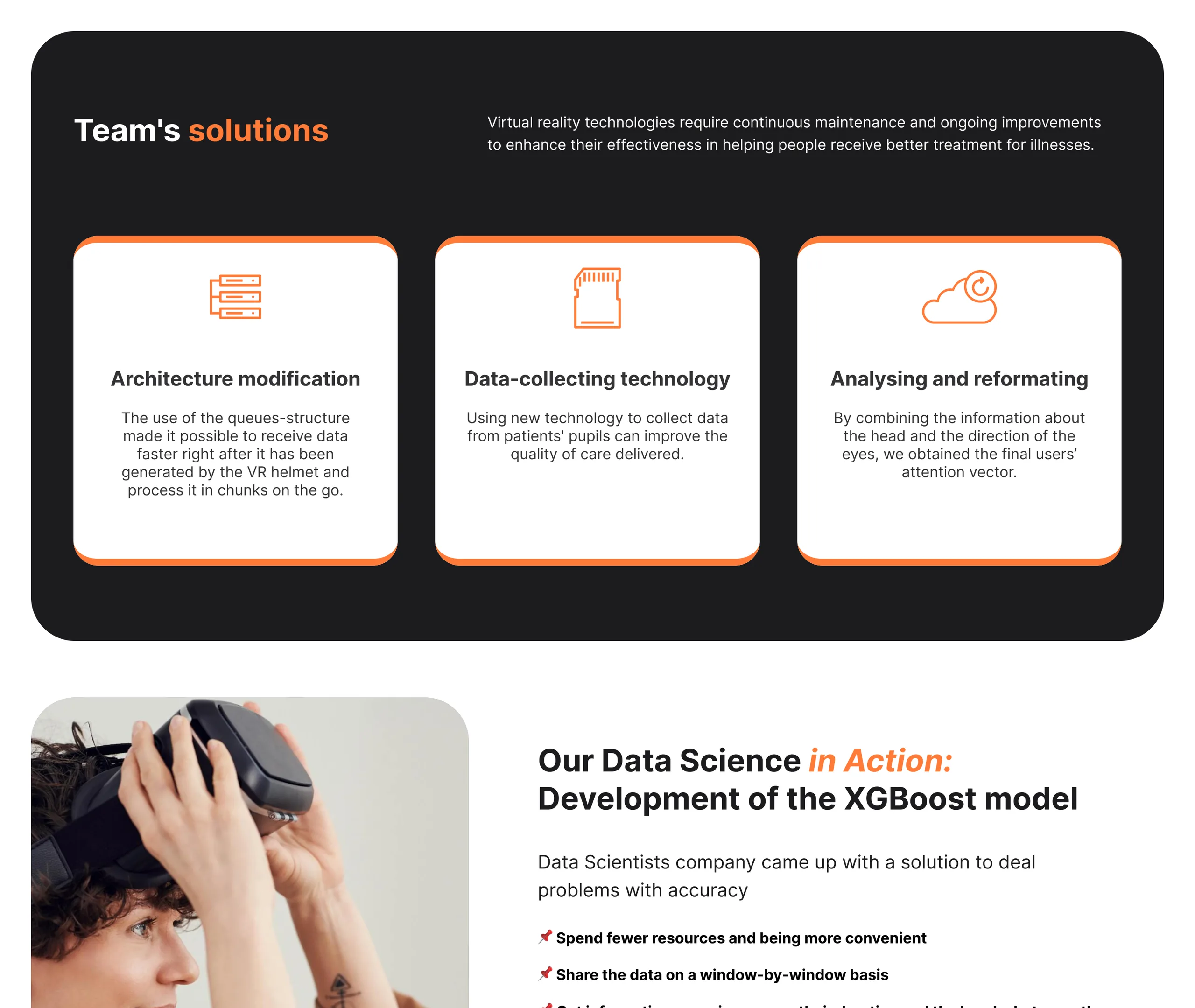
We moved toward a queue-based design so telemetry could be consumed as soon as the helmet produced it, processed in chunks on the go instead of batching everything at shutdown. That reduced latency for staff reviewing sessions and unlocked incremental analytics without blocking clinical workflows.
Data fusion & sensing
Beyond pose streams, the roadmap included richer physiological context - for example, pupil-derived signals to deepen understanding of attention and comfort. By combining head orientation with gaze direction, the product could estimate an attention vector per user, feeding clearer dashboards for clinicians and researchers.
Data science & modelling
The data-science track delivered an XGBoost - based approach to improve accuracy and efficiency: sharing outputs window-by-window, surfacing surges, duration, and gaps in behaviour, and tuning hyperparameters for representative datasets - aligned with tooling such as NumPy, Keras, and matplotlib, with RabbitMQ supporting asynchronous pipelines.
Outcome
Machine learning and streaming analytics together expand what VR can do in healthcare delivery and training: analysing patient data from immersive tools, personalising treatment, spotting patterns, and measuring how technology influences care decisions - ultimately supporting better outcomes and a stronger evidence base for the product.
Ongoing delivery
VR clinical products need continuous hardening: observability for device and session pipelines, versioned model releases, and close collaboration with medical stakeholders. We structured delivery so improvements to acquisition, fusion, and ML could ship incrementally without destabilising live clinics.